
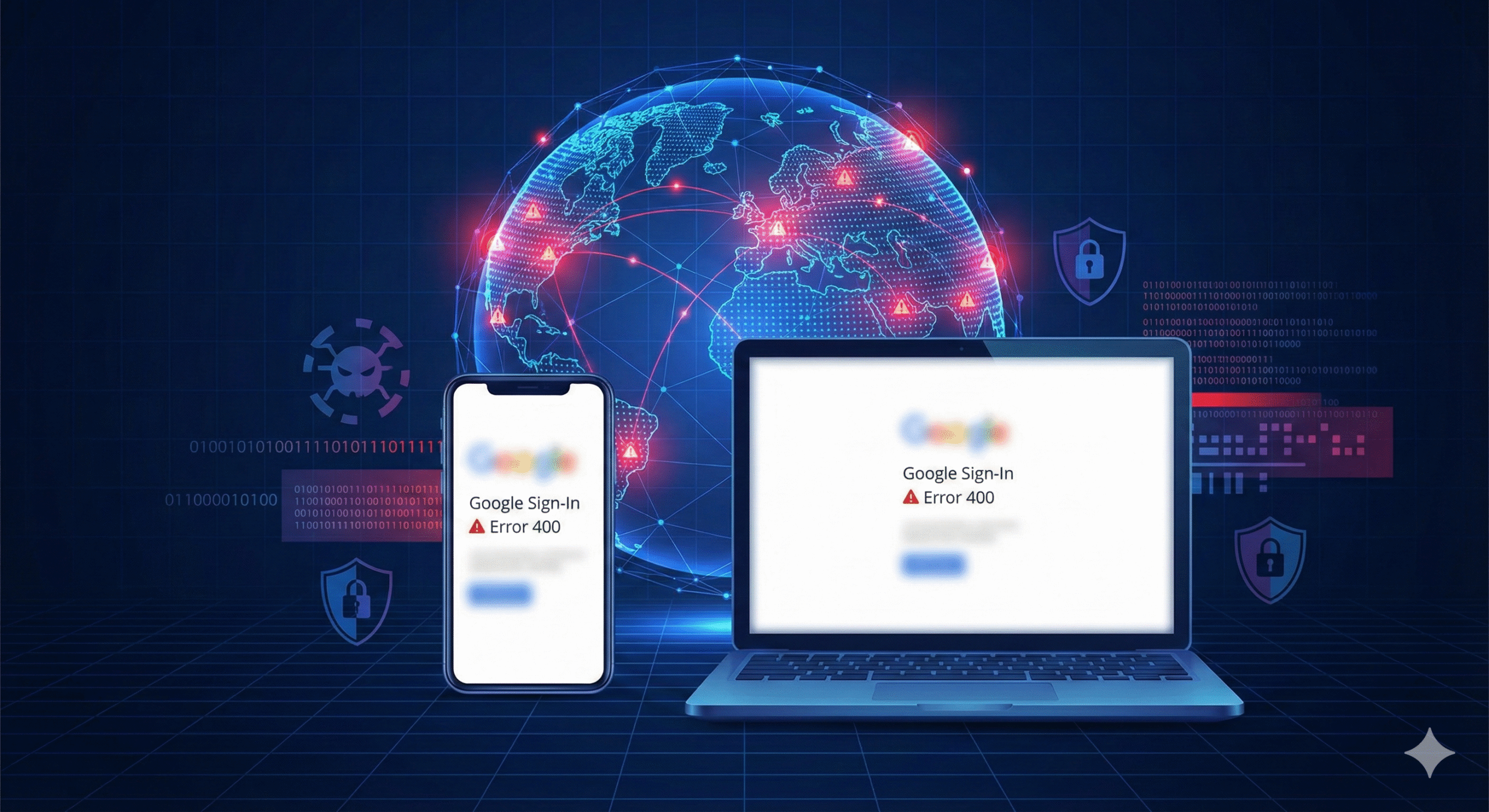
Users worldwide are reporting Google Sign-In Error 400 issues. Is this a simple technical glitch or a possible malware or security-related attack? Read this awareness article to understand the risks and stay protected.
In recent days, users across multiple regions have reported an unusual issue while attempting to access their Google accounts. Instead of a successful login, they are confronted with a message stating: “Error 400 – Bad Request. The server cannot process the request because it is malformed.”
For a company that manages billions of digital identities worldwide, even a short disruption in authentication services is enough to trigger global concern. Google Sign-In is not just a login system; it is the gateway to email, cloud storage, payments, advertising platforms, and thousands of third-party applications.
A Technical Glitch or a Potential Security Threat?
At first glance, Error 400 may appear to be a routine server-side issue. However, cybersecurity experts note that authentication-related errors can sometimes be associated with abnormal request patterns, corrupted cookies, injected scripts, or manipulated session data. Such symptoms are occasionally observed during large-scale cyber incidents, bot interference, or attempted malware exploitation.
According to Google’s own security documentation published on support.google.com, authentication errors can be triggered by malformed requests, outdated browser sessions, or compromised local environments. While Google has not officially confirmed a malware attack, the sudden and widespread nature of this issue has raised legitimate questions among users and security observers.
Why Malware Concerns Are Being Raised
In the cybersecurity world, login disruptions are treated seriously. As explained by Kaspersky Lab on kaspersky.com, attackers often target authentication layers because they provide access to vast amounts of personal and enterprise data. Similarly, Microsoft Security Intelligence reports on microsoft.com/security that malware campaigns frequently exploit moments of service instability to launch phishing or credential-harvesting attacks.
During such incidents, cybercriminal commonly distribute fake alerts, unofficial “fix” tools, and malicious login pages designed to mimic trusted platforms like Google. Users searching for solutions may unknowingly expose their credentials, allowing malware to spread further.
Global Impact on Users and Businesses
Google accounts are deeply embedded into both personal and professional ecosystems. From freelancers and content creators to enterprises running Google Ads and Workspace, login failures can disrupt operations at scale. As noted by Cloudflare’s security blog on cloudflare.com, even short authentication outages can have cascading effects across dependent services.
More importantly, widespread login errors can create confusion, and confusion is exactly what attackers exploit. This is why cybersecurity awareness during such events is critical.
How Users Can Protect Themselves Right Now
Security researchers from The Electronic Frontier Foundation (EFF) emphasize on eff.org that users should never trust unsolicited emails, pop-ups, or links claiming to resolve account access issues. Google does not request passwords, recovery codes, or verification links through unofficial channels.
Users experiencing login issues should rely only on official Google communication channels and avoid third-party apps or websites offering “instant fixes.” Keeping browsers updated, clearing compromised sessions, and enabling two-factor authentication remain essential defensive measures, as recommended by NIST cybersecurity guidelines published on nist.gov.
The Need for Transparency and Awareness
While Google remains one of the most secure digital platforms globally, incidents like this highlight an important truth: no system is immune to disruption. Whether this issue is a temporary technical error or a response to an internal security safeguard, clear communication helps prevent panic and misuse.
At the same time, users must treat every unexpected login issue as a reminder to stay vigilant. Malware awareness is no longer optional; it is a basic digital survival skill in today’s connected world.
Are You Experiencing This Too?
Reports of Google Sign-In Error 400 are emerging from different countries, devices, and networks. If you have encountered this issue, you are not alone. Sharing verified experiences responsibly helps identify patterns and strengthens collective awareness.
Final Thoughts
Google Sign-In errors may be resolved quickly, but the lessons remain long-term. In an age where digital identity equals access to personal, financial, and professional life, even a single login error deserves attention. Awareness, caution, and reliance on trusted sources are the strongest defenses against malware and cyber threats.
About the Business